
If you follow logistics news in India, you could be forgiven for thinking that the entire discipline begins at the delivery van and ends at your doorstep. Last-mile delivery. Hyperlocal fulfilment. Same-day delivery windows. Drone delivery pilots. The logistics conversation in India — particularly in the startup and venture capital world — is overwhelmingly focused on the final few kilometres of a goods journey.
This focus is not irrational. Last-mile delivery is visible, consumer-facing, and generates enormous data. It is also, in the context of India’s total logistics cost problem, almost entirely irrelevant. The last kilometre is not where India loses $180 billion a year. It is where India loses the argument about what logistics technology is actually for.
Where the money actually goes
India’s logistics cost breakdown, when you look at it carefully, tells a story that last-mile obsession obscures. Inventory carrying costs — the cost of goods sitting in warehouses waiting for transport capacity — account for approximately 25 percent of total logistics expenditure. Transportation costs, dominated by road freight, account for approximately 40 percent. Storage and warehousing absorb another 20 percent. The remaining 15 percent is documentation, compliance, and handling at transfer points.
None of these cost categories are primarily a last-mile problem. Inventory carrying cost is high because supply chains are unreliable — goods arrive late or not at all, so buffer stock is held as insurance. Transportation cost is high because road freight is slow, driver-dependent, and operating on infrastructure that was not designed for current traffic volumes. Storage cost is high because goods spend more time stationary than moving.
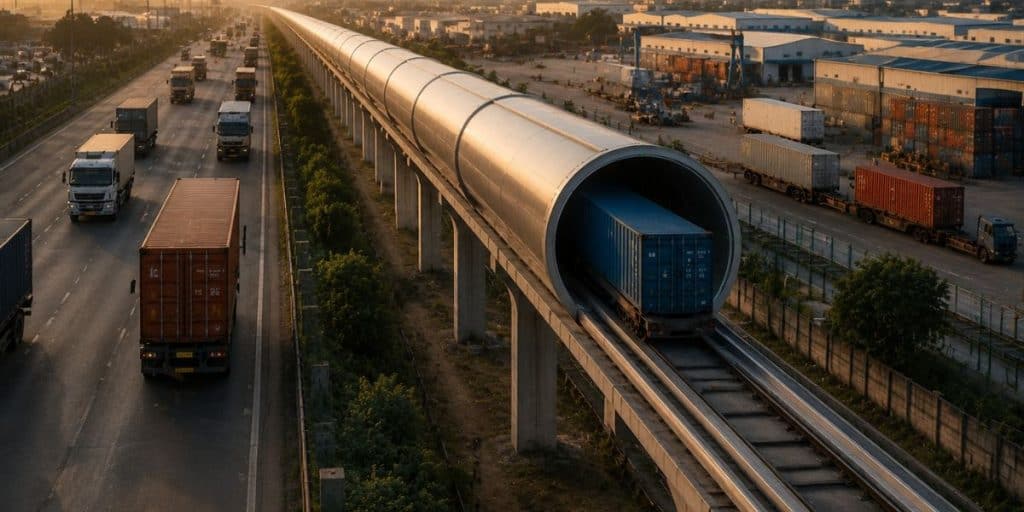
The common thread is middle-distance trunk freight — the 50 to 500 kilometre corridors that connect manufacturing plants to ports, ports to distribution centres, industrial clusters to logistics parks. This is where goods spend the most time, where the most cost accumulates, and where the infrastructure gap is most acute.
Last-mile innovation is optimising the final 1 percent of a journey. Middle-distance infrastructure is redesigning the 80 percent where cost actually lives.
The cold chain illustration
Consider India’s cold chain as a case study. India produces approximately 300 million tonnes of fruits and vegetables annually. An estimated 15 to 18 percent of that production is lost to spoilage before it reaches the consumer — not because of inadequate cold storage at origin or destination, but because the middle-distance transport link is too slow and too unreliable to maintain an unbroken cold chain over 200 to 400 kilometre distances.
A tomato farmer in Nashik supplying a distribution centre in Mumbai does not have a last-mile problem. The last mile — from the distribution centre to the consumer — is efficiently handled by organised retail and quick commerce platforms. The farmer has a 150-kilometre problem. A truck that takes eight hours. A driver who may or may not show up. A refrigeration unit that may or may not maintain temperature over a journey that should take 90 minutes.
The economic loss in that cold chain failure is not captured in any last-mile delivery metric. It shows up as farm gate price collapse, retail shelf gaps, and ultimately food inflation that affects every household in the country. Solving it requires infrastructure that operates at a speed and reliability level that current middle-distance road freight cannot provide.
What $180 billion in inefficiency actually buys
It is worth dwelling on what $180 billion in annual logistics inefficiency represents. It is approximately 5 percent of India’s GDP — permanently. It is more than India’s entire annual defence budget. It is roughly three times the annual budget of the Ministry of Road Transport and Highways. It is not a number that will be moved meaningfully by better delivery apps or smarter route optimisation algorithms.
It will be moved by infrastructure. Specifically, by infrastructure that can move goods autonomously, at high speed, 24 hours a day, without the constraints of driver availability, weather, or road congestion — across the middle-distance corridors where trunk freight actually travels. The port-to-inland connection. The industrial cluster-to-rail head link. The agricultural producing region-to-distribution node corridor.
The reframing that matters
The reason last-mile gets all the attention is partly because it is consumer-visible and partly because it is investor-legible — the unit economics are measurable, the market is large, and the technology is familiar. Middle-distance trunk freight infrastructure is harder to fund, harder to build, and harder to explain. But it is where the economic value lives.India will not close its logistics cost gap through last-mile innovation. It will close it by building the infrastructure layer that makes middle-distance freight fast, autonomous, and always-on — and by treating that infrastructure not as a government project to be debated for decades, but as a commercial deployment problem to be solved in this decade. The $180 billion is not a static cost. At 8-10 percent logistics market growth, it compounds annually. Every year the middle-distance infrastructure gap remains unfilled, the bill gets larger.