
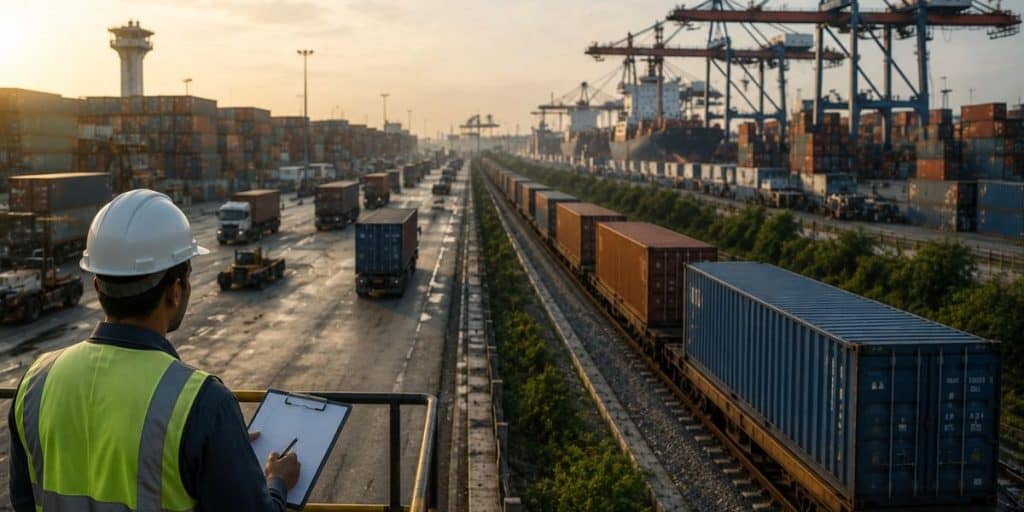
There is a number that does not get enough attention in conversations about India’s economic ambition. Not the GDP growth rate. Not the FDI figures. Not the manufacturing output targets. The number is 13. India spends approximately 13 percent of its GDP on logistics — moving goods from where they are made to where they are needed. The global average for comparable economies is 7 to 8 percent.
That gap is not a rounding error. On a $3.5 trillion economy, it represents roughly $180 billion a year in avoidable cost. Cost that does not create value. Cost that makes Indian manufactured goods less competitive on global markets. Cost that is effectively a tax on every supply chain in the country — paid not to a government but to congestion, inefficiency, and infrastructure that has not kept pace with economic ambition.
The arithmetic of the target
The National Logistics Policy set a target of reducing logistics costs to below 8 percent of GDP. At a $3.5 trillion base, that is a saving of roughly $175 billion annually. At a $5 trillion base — where India is projected to be within this decade — it is a saving of $250 billion a year.
These are not abstract numbers. They translate directly into export competitiveness. Indian manufacturing competes globally on labour cost and scale. But a product that costs 5 percent more to move from factory to port than its Chinese equivalent gives up a significant portion of that advantage before it leaves the country. Closing the logistics cost gap is not a quality-of-life improvement. It is a prerequisite for the manufacturing-led growth model that India’s economic strategy depends on.
Logistics cost is a tax that compounds. Every percentage point reduction adds $5 billion in annual economic value — permanently.
Why the existing infrastructure toolkit cannot close the gap
The honest assessment of India’s current logistics infrastructure is that it was built for a different scale of economic activity and a different set of commercial requirements. The National Highway network is expanding. Dedicated Freight Corridors are being built. Port capacity is increasing. These are necessary investments and they will yield meaningful improvements.
But they will not close the gap alone. The Dedicated Freight Corridor, when fully operational, will reduce average rail freight speeds — from the current 25 kilometres per hour to perhaps 50. That is a significant improvement. It is not the order-of-magnitude change that the logistics cost target requires. Road freight electrification will reduce per-kilometre operating costs. It will not solve the driver shortage that is projected to reach 1.5 million operators by 2030. Port infrastructure expansion will increase berth capacity. It will not compress the gate-to-depot dwell time that accounts for a disproportionate share of total supply chain latency.
The gap between where Indian logistics is and where it needs to be is not a gap that can be closed by doing more of what already exists. It requires a structural addition — a new infrastructure mode that operates at speeds, utilisation rates, and cost points that the existing toolkit cannot deliver.
The compounding argument
The economic case for high-speed autonomous freight infrastructure in India is not just about the direct cost saving. It is about the second and third-order effects. Faster, more reliable freight movement enables just-in-time manufacturing at a scale that road and rail cannot support. It enables agricultural cold chains that reduce food waste — currently estimated at 15 to 18 percent of production — at a national scale. It enables e-commerce fulfilment at speed and cost structures that the current logistics network cannot provide outside of the top six metro areas.
Each of these effects compounds. Reduced food waste is additional agricultural output. Just-in-time manufacturing is lower inventory carrying cost and higher asset utilisation. E-commerce reach into Tier 2 and Tier 3 cities is additional consumption and tax base.
India will become a $10 trillion economy. The question is whether it does so carrying a 13 percent logistics cost burden or a 7 percent one. The difference in the second scenario is not just $300 billion in annual efficiency. It is a fundamentally more competitive manufacturing economy, a more food-secure agricultural sector, and a consumer market that is not constrained by the speed at which goods can physically move. The infrastructure that enables that scenario is not a nice-to-have. It is a structural economic necessity.