
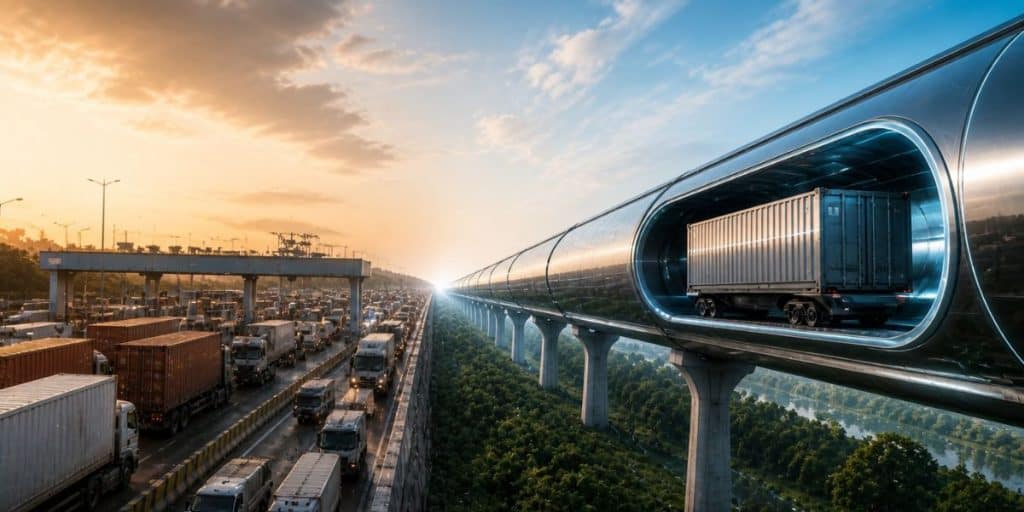
Follow a single consignment. Not a bulk carrier full of iron ore, not a container ship crossing the Pacific. Something ordinary — a pallet of pharmaceutical cold-chain goods, moving from a manufacturing plant in Pune to a distribution hub in Chennai. Watch what happens to it.
It leaves the factory on a truck. The truck joins a highway that was built for a traffic volume that doubled a decade ago. It arrives at a state border and waits — sometimes two hours, sometimes six — at a checkpoint that digitisation has theoretically eliminated but physically has not. It reaches Chennai port’s hinterland and joins a queue of vehicles that stretches back three kilometres from the gate. It enters the terminal. It waits for a crane slot. It waits for documentation. It waits because the system was not designed for the speed at which modern commerce needs to move. The journey of 1,400 kilometres takes four days.
Now ask a different question. Not how do we make that truck faster. But what would it look like if that consignment could move in eight hours, autonomously, without a single human driver, 24 hours a day, without a border wait or a gate queue or a crane slot?
The truck is not the problem
It is tempting to frame India’s logistics cost crisis as a vehicle problem. Better trucks. Electric trucks. Autonomous trucks. But the truck is not the constraint. The road is. The gate is. The three-kilometre queue is. The checkpoint that should not exist is. The crane that is only available during day shifts is.
Logistics inefficiency in India is not a last-mile problem. It is a middle-distance infrastructure problem — the 50 to 500 kilometre range where goods move between industrial clusters, ports, and distribution nodes. This is the range where the throughput failure is most acute, where the cost compounds most aggressively, and where the absence of an always-on, high-speed freight infrastructure layer is most visible.
India spends 13 to 14 percent of GDP on logistics. The global benchmark is half that. The difference is not explained by last-mile delivery costs. It is explained by what happens in between — the dwell times, the congestion multipliers, the driver-shift constraints, the infrastructure that was built for a different era of commerce.
We are not moving goods slowly because we lack technology. We are moving goods slowly because we built our infrastructure for a world that no longer exists.
What always-on actually means
The phrase ‘always-on freight’ sounds like a marketing tagline. It is not. It is a description of an operational characteristic that conventional freight infrastructure — road and rail both — cannot deliver. A truck driver works eight hours and then legally must rest. A train runs on a schedule. A port crane operates in shifts. Every one of these constraints introduces latency into a supply chain that modern commerce has zero tolerance for.
An electric, autonomous freight system has no driver shift. It does not take a rest break. It does not slow down because it is raining or because traffic ahead has stopped. At 150 kilometres per hour, a corridor that takes four hours by truck takes 40 minutes. Repeated, continuously, 24 hours a day. The throughput mathematics are not incremental — they are categorical. You are not improving the existing system. You are replacing it with a different operating model.
Why this decade and not the last one
The technology components that make high-speed autonomous freight viable — linear propulsion systems, electromagnetic control, battery storage, AI-native dispatch — have each individually reached commercial maturity in the last five years. The cost of energy storage has fallen 60 percent. The cost of power electronics has followed. The policy infrastructure for multimodal freight corridors, in India and globally, has been put in place. The demand signals — port congestion, driver shortages, e-commerce velocity, net-zero mandates — have converged simultaneously.
Five years ago, the business case for a new freight infrastructure mode required government capital at sovereign scale. Today, a closed-loop industrial corridor — port gate to inland depot, mine site to processing plant — can be built and operated as a commercial enterprise, funded by the customers it serves, generating revenue from the first paid demonstration.The consignment that takes four days today is the proof of concept for the one that takes eight hours tomorrow. That is not a vision statement. It is an engineering and deployment problem. And those are the best kind.