Large-scale national infrastructure programs are prioritising freight corridors. Pilot corridors identified; government support in place.
Energy storage and power-electronics costs have dropped ~60% over the last decade — bringing TuTr CAPEX well below global high-speed rail.
Mainstream EV adoption is accelerating certification pathways and public acceptance for electric freight at scale.
India's $250B logistics market is growing at 8–10% CAGR. Every efficient kilometre directly compounds national GDP.
Incremental improvements will not unlock the efficiency upside. The next freight layer will.
Global logistics spend
of GDP
of GDP
of GDP
of GDP
India logistics inefficiency cost
TuTr’s cargo-first corridors sit alongside road, rail, and air — a fourth logistics mode purpose-built for 24/7 electric freight at 6× truck throughput and a fraction of rail’s per-km cost.
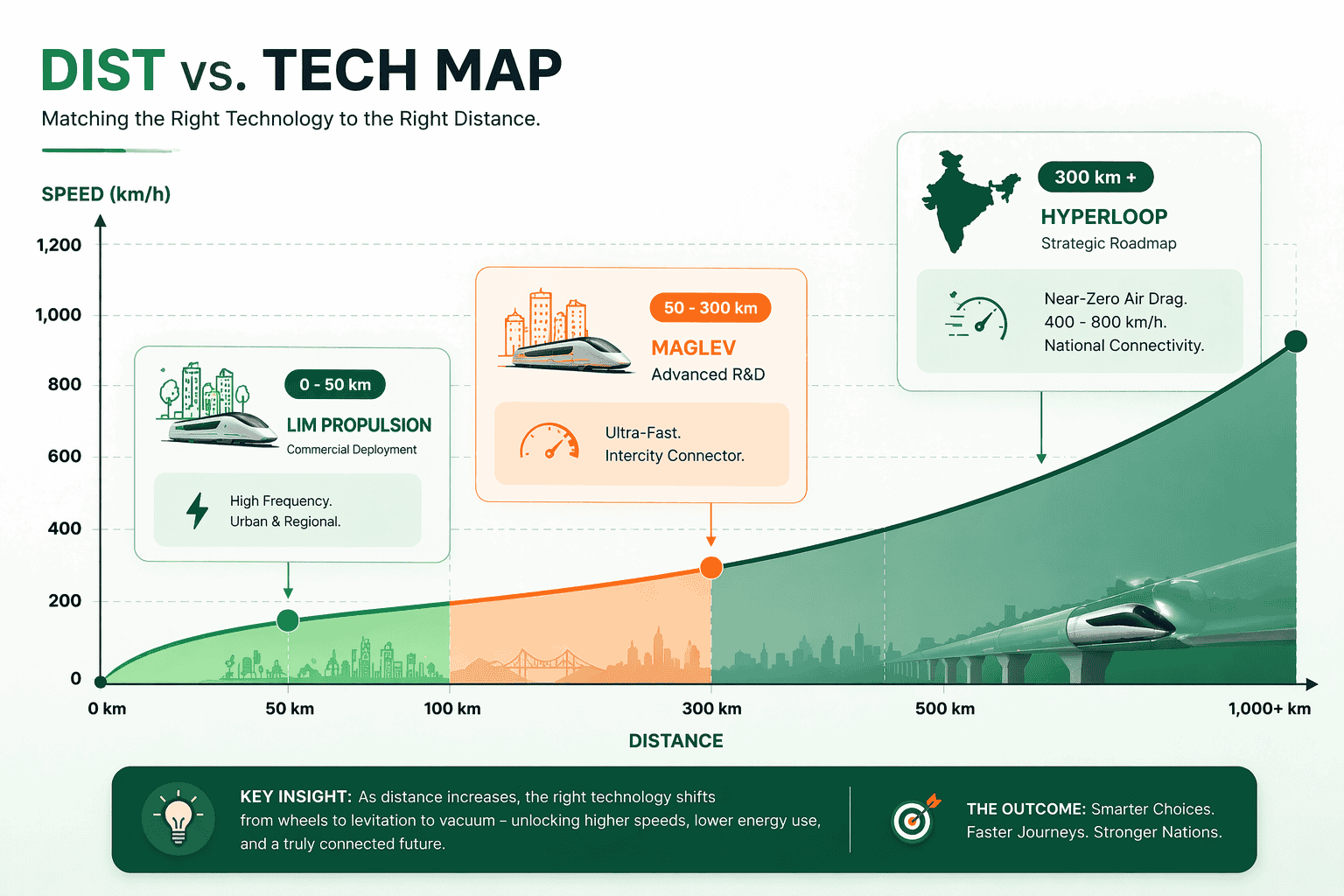
Our LIM technology is the immediate answer to localised bottlenecks where traditional wheels and diesel engines fail.
Fastest regulatory path + lowest certification risk + customer-funded POCs — proves every subsystem in production.
Intra-port container movement and port-to-inland evacuation — eliminating gate congestion across the first 5–20 km.
Validation: 19.6 Cr + GST Major Port Authority Project · E20 Cr Container Yard Execution
LIM’s superior grade-climbing ability replaces diesel locomotives on steep inclines where conventional traction fails.
Validation: 18 km Mountain Corridor — Advanced Stage
LIM propulsion retrofit for existing metro subsystems — higher frequency, lower energy, no pantograph dependency.
Validation: ₹50 Cr Kolkata Metro Subsystem Contract
Autonomous, high-tonnage material movement across mine sites and heavy industrial zones — replacing diesel haulage with zero-emission electric propulsion.
Pipeline: 80 active
Frictionless · Medium-to-Long Distance. Electromagnetic Levitation for distances of 100–300 km between industrial clusters.
Frictionless cargo movement between manufacturing clusters, SEZs, logistics parks, and port hinterlands — 100 to 300 km range, 24/7 autonomous throughput.
e.g. Chennai–Bengaluru · Delhi–Mumbai Industrial Corridor · 1 SEZ pilot in discussion
Temperature-sensitive cargo — food, dairy, pharma, floriculture — that currently moves by road within 100–300 km. MagLev speed eliminates spoilage risk and driver-shift constraints.
India cold chain market $28B+ · growing at 14% CAGR
Rapid, autonomous movement of equipment and supplies across strategic corridors — immune to road congestion and weather disruption. Sovereign, electric, driverless.
Closed-loop operation · no civilian certification dependency
High-speed freight across neighbouring economic zones where road and rail fall short on speed and reliability — GCC, South Asia, Southeast Asia.
GCC $150B logistics market · South Asia trade growing 9% CAGR
Ultra-High Speed · Long Distance · Passenger & High-Value Cargo. Vacuum environment for distances exceeding 500 km.
Pharmaceuticals, semiconductors, perishables, and high-value manufacturing inputs that demand air-freight speed at a fraction of the cost and emissions.
Replaces domestic air freight on trunk lanes · 90% lower emissions
Ultra-fast, predictable delivery for next-day and same-day fulfilment networks — connecting warehouses to urban distribution hubs at hyperloop speed.
India e-commerce logistics growing at 25%+ CAGR
Always-on, high-speed passenger mobility across India’s megacity corridors — 500 km+ in under 90 minutes. The platform’s end state. Full TAM unlocks here.
2035 passenger goal · $300B+ global passenger-rail market
Long-haul freight across continental corridors — India to Middle East, intra-Europe, intra-Southeast Asia — where air is too expensive and sea is too slow.
Europe $550B logistics · complements existing multimodal networks