
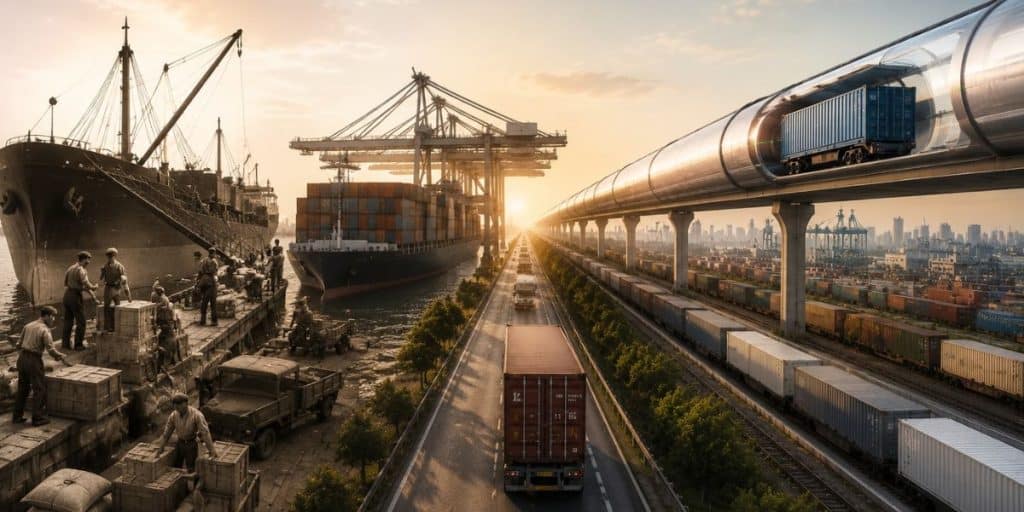
In April 1956, a converted tanker called the Ideal X left Newark, New Jersey, carrying 58 metal boxes on its deck. The boxes were a standardised size. They could be loaded by crane, stacked on a ship, transferred to a truck chassis, and moved to a warehouse without ever being opened. Their contents — whatever was inside — were irrelevant to the logistics system handling them. Only the box mattered.
Malcom McLean, the trucking entrepreneur who owned the ship, was not an engineer. He did not invent the shipping container. Standardised boxes had been discussed and partially implemented for decades before 1956. What McLean understood — and what the industry had systematically failed to understand — was that the value of the container was not in the box itself. It was in the system that the box made possible. A system where every node — crane, ship, truck, warehouse — was designed around the same unit. Where the cost of handling was not in the movement of goods but in the interface between modes.
The pre-container world looks familiar
Before containerisation, port operations were a study in organised chaos. Ships arrived and were unloaded by gangs of dock workers, piece by piece, crate by crate, sack by sack. A large vessel might take three weeks to unload. The cargo sat on the dockside waiting for trucks or trains. The trucks or trains sat waiting for the cargo to be organised. Every transfer between modes required repacking, rehandling, and reprocessing.
The cost was not primarily in the ocean crossing. It was in the time and labour spent at every point where goods changed hands. The port was not a through-put node. It was a bottleneck — a place where the supply chain slowed to the pace of human physical labour.
This should sound familiar. Today’s freight system has different technology but structurally identical failure modes. Containers move efficiently across oceans. They slow to a crawl at port gates. They queue on highways behind other containers that are also queuing. They wait for crane slots, driver shifts, documentation processing, and customs clearance. The ocean crossing — the expensive, capital-intensive, technologically sophisticated part of the journey — is not where the time is lost. It is at every interface where goods move from one mode to another.
McLean did not make ships faster. He redesigned the interface between modes. That is where every logistics revolution has always happened.
What the container revolution actually did
Containerisation reduced the cost of shipping a tonne of goods from the United States to Europe by approximately 90 percent between 1956 and 1976. It did not do this by making ships larger, though they did get larger. It did not do this by making engines more efficient, though they did become more efficient. It did this by eliminating the labour and time cost at every interface — by making the transfer between ship, truck, and rail instantaneous, standardised, and human-independent.
The consequence was not just cheaper shipping. It was a restructuring of the global economy. Manufacturing moved to wherever it was cheapest because the cost of moving the finished product had become negligible relative to the cost of making it. Global supply chains became not just possible but economically dominant. The world we live in — where a t-shirt is designed in California, made in Bangladesh, and sold in Germany — is a direct consequence of McLean’s 58 boxes.
The next interface problem
The container solved the ship-to-land interface. The next unsolved interface is the gate-to-depot connection — the 50 to 500 kilometre range where goods move from port hinterlands, manufacturing clusters, and logistics parks to their next destination. This is the range where road freight is too slow and too constrained by driver availability, where rail is too inflexible and too scheduled, and where air freight is too expensive for anything other than the highest-value cargo.
The technology components for a new interface solution in this range — linear propulsion, autonomous control, electric power — are commercially mature. The standardisation challenge is analogous to McLean’s: not inventing new technology, but designing a system where every node is built around the same unit, the same interface, the same operating parameters. Where the cost of handling is in the movement, not in the interface.
McLean was told his container idea was impractical. The dock workers’ unions opposed it. The shipping companies said it would never work at scale. The infrastructure did not exist. He built the infrastructure. Sixty years later, 90 percent of global trade moves in containers.
The freight system of 2050 will look as different from today’s as today’s looks from 1955. The interface that changes it will not be the ocean crossing or the last mile. It will be the middle distance — always-on, autonomous, high-speed, electric. The question is not whether it gets built. It is who builds it first.